High Tech Babies
 On Monday my class on Science, Technology, and Politics will host a public lecture by Miriam Zoll, award-winning author of Cracked Open: Liberty, Fertility and the Pursuit of High-Tech Babies.
The book is an engaging, intensely personal memoir of Zoll’s five-year odyssey of using various assisted reproductive technologies to try to have a baby. Beginning when she was forty, Zoll and her loving husband go through several cycles of in vitro fertilization (IVF). Three attempts fail completely and one ends with a miscarriage.
Their next step is egg donation, and they worry about the ethical issues it raises. Ads in campus newspapers at Ivy League colleges have offered up to $100,000 for eggs from blonde women with high SAT scores and musical talent. And egg donation is a physically taxing process with potential risks to the donor. But having become “fertility junkies,” Zoll and her husband work with a clinic to make laborious arrangements with two egg donors, both of whom turn out to be infertile.
In the end, they happily adopt a child. Zoll makes clear, however, that her odyssey has left a mark. Many women who go through failed fertility treatments, she reports, experience symptoms that meet the criteria for post-traumatic stress disorder.
Assisted reproductive technologies have helped millions of people. But in the United States they are largely unregulated, and fertility clinics often seem driven more by financial interests and technological optimism than genuine medical concern.
One of the book’s main messages is that many young people lack basic information about human fertility and the success rate of IVF techniques.
According to a 2012 survey of undergraduates in the United States, Zoll reports, about half intended to have their last child between the ages of 35 and 44, but over two-thirds thought that female fertility does not significantly decline until after age 40. And well over half overestimated the chances of a woman conceiving after one IVF treatment. According to the Society for Assisted Reproductive Technology, the rate of live births for women age 35-37 is about 30 percent, and for women 41-42 it’s about 12 percent.
Zoll’s mission is not to demonize assisted reproductive technologies, but to foster realistic public discussion about them. As she proceeds though the “fertility casino,” she learns that such discussion isn’t easy.
I was discovering that many couples whose treatments had failed never wanted to talk about it — and who could blame them? There was a cultural taboo, reinforced by the clinics themselves, that said we shouldn’t talk about our infertility or our miscarriages or the inability of science to solve our reproductive health challenges. It was this absence of truth telling that made the success stories sensationalized in the media so dangerously misleading.
For more on these issues, also see Zoll’s recent opinion piece in the New York Times.
If you’re in Sacramento, Zoll will be giving a public lecture on Monday, October 14, 3:00 – 4:15 p.m. in Mariposa 1000 at Sacramento State.
And she is scheduled to speak at the Avid Reader bookstore in Davis on Sunday, October 13 at 4:00 PM.
Students alone together?
This week in one of my classes we read part of Sherry Turkle’s Alone Together: Why We Expect More from Technology and Less from Each Other.
Turkle argues that social media have led to more connection but less conversation, more information transfer but less mutual understanding.
I was half-expecting many students to scoff at such hand-wringing, but they’ve actually responded with genuine interest and concern about how digital technologies have come to dominate their everyday lives.
I also asked my students to complete an informal Electronic Devices Survey. Out of 43 students surveyed:
- 2 do not have a computer at home
- 3 do not have a cell phone
- 7 believe laptops should be entirely banned from the classroom
- 9 check their emails or messages 5 or more times per hour
- 24 tend to check email, texts, or other social media while reading for their courses
- 36 sometimes feel that electronic devices distract them from other activities.
Several students have posted thoughtful reflections on their relations with cell phones on the public course blog. One student shared this brilliant and rather disturbing video:
Another student said that at the Starbucks where he works, it’s increasingly the older customers who annoy everyone by trying to place an order while texting.
The younger folks are realizing that “continuous partial attention” not only leads to superficial relationships, bad grades, and car accidents. It’s also just incredibly obnoxious.
Electronics in the classroom
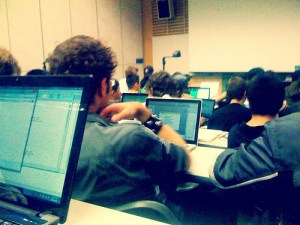
The summer is a memory, the new semester is well underway, and among other things, I’ve been pondering my approach to laptops and other electronic devices in the classroom. For several years now, I’ve banned laptops in my classes (with some exceptions), due to the many distractions they create. Whenever I polled my students, most said it was a good policy. And a lot of research suggests that multitasking is a myth.
But during the past year or so, many of my students have been turning to e-books for their course texts, and many no longer print out the assigned articles but read them online instead. One student last semester even did all her reading on her smart phone.
So I had to either stop asking them to have the reading in front of them during class, which is often useful for discussing difficult passages in philosophical texts, or I had to give up my laptop ban.
I talked with several colleagues about it. One colleague bans all electronic devices and asks students to leave if they sneak a look at their phone. Another waits until he sees students checking email or texting and them asks them to stop. Another says students are becoming more disciplined and it’s not really a problem anymore. Yet another takes a laissez-faire approach, saying that if students distract themselves or each other, that’s their problem.
I got out my laptop, of course, and went looking for further input, and found useful articles here and here.
For better or worse, here’s what it now says in my syllabus:
Wireless Devices
Some students like to use a laptop, tablet, or smart phone to take notes during class, and some students use wireless devices to read assigned articles and books. But in a classroom, wireless devices can be extremely distracting, not only for the person using the device but also for other students and the instructor. Several studies have shown that wireless devices may reduce student learning. The general policy of this course is that wireless devices may be used to take notes, but the wireless receiver must be turned off. Cell phones must be turned off or set to vibrate or mute. I will also ask students to close or put away wireless devices at specific times, such as during class discussions or when students are working in small groups. And of course students may not use wireless devices during exams, and not at any time for surfing, shopping, texting, playing games, checking email, or any other activities not directly related to the course. Violations of this policy will affect your grade. If you require special accommodation in this regard, please let me know.
So far it’s working out alright.
And although my students disagree on the policy itself, they have been eager to talk about it, which suggests that civilization may not be doomed after all.
Jeff Lustig Symposium

Today at Sacramento State we’re hosting a symposium to honor our friend and colleague Jeff Lustig who died last June. Short talks by distinguished speakers will address the themes of Jeff’s work, focusing on California political ideas, history, and culture. The event is from 5:30 to 8:30 p.m. at the Sacramento State Alumni Center.
We’ll also announce the winner of the first Jeff Lustig Memorial Prize for an undergraduate research paper on social and political theory, university politics, and/or California politics.
Speakers include:
William A. Dorman, Professor of Government, Emeritus, Sacramento State
Pia Lopez, Associate Editor, Sacramento Bee
Steve Lustig, Associate Vice Chancellor Emeritus, UC Berkeley, and Jeff Lustig’s brother
Charles Postel, Professor of History, San Francisco State
John Syer, Professor of Government, Emeritus, Sacramento State
Richard Walker, Professor of Geography, Emeritus, UC Berkeley
Update: A video of the event is available here.
Robot graders for the poor
 Having stayed up late last night grading student essays, it was a special treat this morning to read on the front page of the New York Times that new grading software could have completed my work in seconds.
Essay grading software has been around for a while, but the article reports that EdX, a Harvard-MIT nonprofit online education provider, has developed new and improved software that will be available free online.
The problem is not only that such efforts exaggerate the educational potential of automated grading. And I could actually imagine that students might find it useful for improving early drafts of their papers, which they could then submit to a professor for evaluation and discussion.
What really bothers me is the gee-whiz reporting on educational technology, ignoring the economic conditions and political choices that got us into this mess.
The Hewlett Foundation recently sponsored a contest for designers of essay grading software, and one of the winners is now working on the project for EdX. The Times article reports:
“One of our focuses is to help kids learn how to think critically,” said Victor Vuchic, a program officer at the Hewlett Foundation. “It’s probably impossible to do that with multiple-choice tests. The challenge is that this requires human graders, and so they cost a lot more and they take a lot more time.”
This statement implicitly acknowledges the economic pressures driving the recent MOOC craze, but the article says nothing about such pressures. The article then summarizes the comments of Mark D. Shermis, a professor who supervised the contest:
With increasingly large classes, it is impossible for most teachers to give students meaningful feedback on writing assignments, he said. Plus, he noted, critics of the technology have tended to come from the nation’s best universities, where the level of pedagogy is much better than at most schools.
It’s doubtful that undergraduates at “the nation’s best universities” are more likely to enjoy professors with high-level classroom pedagogy, given that most such universities reward their faculty almost entirely for research and not teaching. And to the extent that the “level of pedagogy” is better at elite schools, my guess is that it’s primarily due to better conditions (smaller classes, lower faculty teaching loads, more resources), rather than better faculty pedagogy as such.
But what’s really infuriating about such statements is the way they treat “increasingly large classes” as a natural event, rather than the result of political decisions. For decades now, politicians and administrators have systematically defunded public higher education, and now we’re being told that the only remedy is to replace faculty with robots.
And even worse, the economic pressures that make automated grading seem attractive could easily lead to further degradation of academic work. As Jonathan Rees wrote a year ago:
Once you demonstrate that you can handle 50 essays per week with this new automated tool, they’re not going let you start assigning two essays per week. They’re going to double the size of the class to 100. Why? Because they can, that’s why. . . . The goal of automation is not to provide a better education. It’s to save taxpayers and students money.
So it really misses the point to argue about whether automated grading is good pedagogy. Let’s talk about the money.
Juicy MOOC meat
There’s nothing wrong with fighting a losing battle. But try not to fight the wrong losing battle.
Yesterday California’s State Senate President Pro Tem Darrell Steinberg introduced legislation that would require California public universities to award credit for online courses taught by outside institutions, including MOOCs (massive open online courses) taught by private companies like Coursera or Udacity. The goal is to reduce overcrowding and help the almost half million students at community colleges who are on waiting lists for the basic courses they need to graduate.
The draft legislation includes various measures to try to ensure educational quality, and that’s been the focus of discussion in The New York Times and The Chronicle of Higher Education.
Unfortunately, the ongoing debate over the quality of MOOCs is a massive distraction from more fundamental obstacles to improving public higher education.
As Michael Meranze points out,
someone might be given pause by the fact that the Steinberg bill is an example of providing private capital with state funds rather than investing it in public education; that the usual venture capitalists are out in force insisting that this is all about access without mentioning their financial interests in this proposal, and that ACE [American Council on Education] is helping to streamline access for private corporations to capture markets with public authority.
Debating MOOCs also offers a comfortable way to avoid talking about spending priorities. Here are two often mentioned possibilities for improving public education with existing state revenue:
At the university level, shift funding from administration to instruction. According to the statistical abstracts for faculty and staff on the CSU website, between 1980 and 2010 the total number of faculty (full-time and part-time) went from 18,129 to 21,384. The number designated as “Executive, Administrative, Managerial, and Other Professional” went from 5,301 to 12,018. Put differently, between 1980 and 2010 the number of faculty increased by 17 percent, while the number of administrators increased by 127 percent.
At the state level, move funding from prisons to education. According to one recent analysis, “After adjusting for inflation, higher education in 2011 received 13% less State funding than it did in 1980. Corrections, on the other hand, expanded its share of the State’s General Fund by 436%.”

These are just two examples of the kind of things we’re not talking about when we’re talking about MOOCs.
All this reminds me of a line from the 1964 book Understanding Media by Marshall McLuhan:
Our conventional response to all media, namely that it is how they are used that counts, is the numb stance of the technological idiot. For the “content” of a medium is like the juicy piece of meat carried by the burglar to distract the watchdog of the mind.
McLuhan argued that people tend to focus their attention on the explicit content of a medium, such as the story told by a play or a film. But media always create effects that go beyond their explicit content. A film and a book might tell the same basic story, but they obviously create very different experiences.
Debates about MOOCs focus on the educational content of the technology, forgetting to ask whether even the best possible online courses would actually address the basic challenges facing public universities today.
I’m also reminded of that mantra of modern parenting: “pick your battles.” In politics that’s not always possible, but it’s worth remembering the battles we’re not fighting.
Thanks for the techno-fix!
 His condescension is astounding. Not to mention his apparent ignorance about the real obstacles to better university teaching. In his column in yesterday’s New York Times, Thomas L. Friedman kindly informs us that MOOCs (massive open online courses) will finally force professors to improve their pedagogy.
“Institutions of higher learning must move, as the historian Walter Russell Mead puts it, from a model of ‘time served’ to a model of ‘stuff learned.'”
“The world of MOOCs is creating a competition that will force every professor to improve his or her pedagogy or face an online competitor.”
Friedman seems to think that most university classes today consist of a drab professor droning on from yellowed notes, while bored students nod off while staring at the clock. That’s a fun stereotype, and maybe some faculty still teach that way. There’s certainly a lot of room for improvement. But the university landscape is extremely diverse, and my guess is that for every “sage on the stage” there are many more instructors who give dynamic interactive lectures and push their students to become actively involved in classroom discussion.
I agree with Friedman that good pedagogy emphasizes learning by doing. Or as Friedman puts it, with characteristic job-market anxiety, “The world only cares, and will only pay for, what you can do with what you know.” Whether the course is microbiology or ancient philosophy, students learn best through exploring how and why knowledge makes a difference in the world. But that isn’t news to most faculty.
There is also much to say, as Friedman insists, for a “blended model” that “flips the classroom” by asking students to watch online lectures at home, thus freeing up time for more discussion in the classroom.
But the notion that MOOCs are the solution to our alleged pedagogical malaise is not only insulting, it also amounts to a naive techno-fix that distracts from more fundamental obstacles to improved pedagogy. As in an earlier column on this subject, Friedman says nothing about the massive defunding of public higher education, the replacement of tenure-track positions with second-class contingent faculty appointments, or the economic burdens on many students that require them to work long hours at low-paying jobs, thus having less time for study.
Addressing those issues would do a lot more to improve university pedagogy than Friedman’s breathless bluster about canned online lectures by a few superprofessors.
Univ. of Maryland contingent faculty task force
Today the Chronicle of Higher Education has a story on a groundbreaking task force report on contingent faculty at the University of Maryland. The report “proposes sweeping changes intended to give non-tenure-track faculty members more pay, job security, respect, and clout.”
Among other things, the Chronicle reports,
The task force’s survey of faculty members found substantial levels of dissatisfaction over compensation, workload, access to funds for professional development, and criteria used by their superiors in weighing promotions and merit-pay increases. Many have little knowledge of their department’s policies that affect them or of opportunities to participate in the university’s shared governance.
Among its recommendations, the report calls for creating a new career track, with benchmarks for evaluation and promotion, for non-tenure-track faculty members who primarily teach. Noting that many such faculty members do additional work, such as advising students, for which they are not paid, it says administrators should compensate them for tasks beyond those specified in their contracts.
With regard to the university governance issues I wrote about in my last post, the task force recommendations include:
Increase the representation of NTT [non-tenure-track] faculty in the University Senate.
Ensure that departments and colleges have written policies for including NTT faculty in unit level self-governance for matters that involve them.
The task force report draws on a survey of contingent faculty (available here) that includes questions on contracts, pay, working conditions, responsibilities, contributions, social recognition, political inclusion, and many other areas. (It’s far more detailed than the survey of department chairs I’ve been working on for my College at Sacramento State, which I’ll write about soon.)
It’s about time that we conduct a similar survey of the people who do far more than many realize to keep the lights on at Sacramento State.
Contingent academic democracy
If asked to list what they like most about their jobs, most university faculty would not put department meetings and committees at the top.
Nonetheless, a key part of academic self-governance occurs in university departments. Department committees address all manner of issues large and small: faculty hiring and evaluation, curriculum changes, equipment purchases, student awards, and so on. At meetings of the full department, faculty share information, discuss plans, and vote on policies. And if you’re lucky to be in a department like mine, where people generally get along, department meetings can actually be kind of fun.
Unfortunately, the faculty who teach the most students — faculty with part-time, adjunct, contingent appointments — are often excluded from university self-governance. And even when they hold seats on a university-level Faculty Senate, as they do at my university, contingent faculty may not be invited to participate in department-level meetings and committees.
But contingent faculty participation varies widely, “with some institutions encouraging it, some allowing it, and some barring it,” according to a recent report by the American Association of University Professors (AAUP), “The Inclusion in Governance of Faculty Members Holding Contingent Appointments.” (For a discussion, see this article on “Making Room for the Majority.”)
The AAUP report notes that excluding contingent faculty from academic self-governance has many implications for instructional quality, academic freedom, and faculty morale.
The causes and repercussions of a system in which some faculty receive vastly more compensation, privilege, autonomy, evaluation, information, professional support, and respect than others extend far beyond governance. But the routine exclusion of some faculty from department meetings, curricular planning, and other governance activities does much to foster the sense of inequity.
The AAUP report discusses several common concerns about participation by contingent faculty in university governance, such as: 1) if contingent faculty only teach occasionally, they may not know the university very well or have much stake in how it’s run; 2) contingent faculty may not have the professional qualifications or job experience needed to evaluate tenure-track faculty for tenure and promotion; 3) since contingent faculty do not have tenure, they may be vulnerable to pressure from administrators or tenured faculty; and 4) contingent faculty are usually not paid for governance activities.
Rather than taking such concerns as decisive, the AAUP report discusses strategies for addressing them.
1) On the question of part-time faculty who teach only one or two courses per year or whose primary employment is elsewhere, the report states:
Since the part-time faculty in question here do teach courses, they are members of the faculty, are experienced with their courses and their students, and should be involved in curricular planning and similar work. While it would likely not be appropriate for a person who either has another career or teaches at several institutions and has little interest in the one in question to assume a major faculty leadership role, such a person would be unlikely to stand for election to an important governance role and would be unlikely to get elected.
Moreover, the report notes, many full-time tenured faculty show little interest in their institutions, and many have substantial outside employment, and yet they are not excluded from university governance.
The report also proposes a “time-in-service threshold” for governance activities, applicable to both contingent and tenure-track faculty.
2) With regard to performance evaluation, the AAUP report notes that when contingent and tenure-track faculty have different job duties, asking the former to evaluate the latter may not be practical. But the report criticizes the common practice of allowing a single department chair or administrator to evaluate contingent faculty, as well as the tendency to rely solely on student evaluations:
While faculty on contingent appointments may be restricted from participating in the evaluation of tenured and tenure-track faculty, faculty on contingent appointments should have the opportunity to contribute to the evaluation of other contingent faculty.
That is, contingent faculty hiring committees should include contingent faculty.
3) And what about contingent faculty who dare to challenge the views of tenured faculty and administrators? Aren’t they vulnerable to retaliation? Yes, they are, but the AAUP report argues that “the solution is not to bar some faculty from service but to better protect the academic freedom of those serving in governance roles.”
The governance system must be protected by the most rigorous possible commitment in spirit, in writing, and in fact to prevent retaliation against all those who voice opinions in the governance process that may offend those with more power.
Tenure-track faculty without tenure face similar risks, but they are not excluded from academic self-governance.
4) Finally, with regard to the important concern that contingent faculty are generally not paid for governance activities, the report considers but rejects the possibility of direct payment for participation, noting that it would create undesirable incentives. But compensation for service can be incorporated into contingent faculty contracts.
Faculty holding contingent appointments should be compensated in a way that takes into consideration the full range of their appointment responsibilities, which should include service. Where such compensation does not exist, its absence should not be used to exclude faculty on contingent appointments from voluntarily serving in governance.
As long as contingent faculty are not paid to participate in university governance, we shouldn’t require it, but excluding them for that reason only makes a bad situation worse.
Given how much tenured faculty complain about committee work, it’s a bit suspect that we haven’t been willing to share it more widely.
CSU Teaching Symposium
Yesterday I attended the annual CSU Teaching Symposium on the campus of the California Maritime Academy in Valejo. It was fun to meet faculty from all over California, and I left with some useful ideas for improving my teaching. I was also reminded how difficult it is to make the most of those few hours in the classroom every week. Here are some of the more promising suggestions:
- Use Skype to arrange virtual classroom visits by interesting people of all kinds, especially authors the students have been studying, who may be too far away or too expensive for a live visit.
- Use VoiceThread.com to allow students to post online spoken comments on course readings or other materials.
- Get students moving with various “up and out” (of their seats) exercises. Research suggests that many people learn better when they combine cognitive and physical activities. For example, place various pictures on the classroom walls, and then ask students to go stand next to the picture that best represents their view of the author they’ve been studying, and then talk with whomever else shows up. Or give students playing cards and ask them to wander around the room until they find people with a card of the same number, and then work with those people to discuss a question posted on the screen. (Not sure how well these exercises will work in my overcrowded classrooms, but I’ll try it.)
- Give students more choice about what kinds of assignments to complete, thus allowing for different learning styles and encouraging students to take more responsibility for the course.
I also heard a lively lunchtime lecture by Dr. Elizabeth Barkley, author of Student Engagement Techniques: A Handbook for College Faculty (Jossey-Bass, 2010). Among other things, she discussed the relationship between students’ perceived value of the tasks we ask them to complete, on one hand, and their personal expectations of success, on the other. Students might think the assigned task is valuable, but assume they can’t succeed. Or they might think they can easily succeed at the task, but consider it boring. Given that students are very different, finding assignments that all students consider both worthwhile and appropriately challenging isn’t easy.
Onward.


 Whose University?